
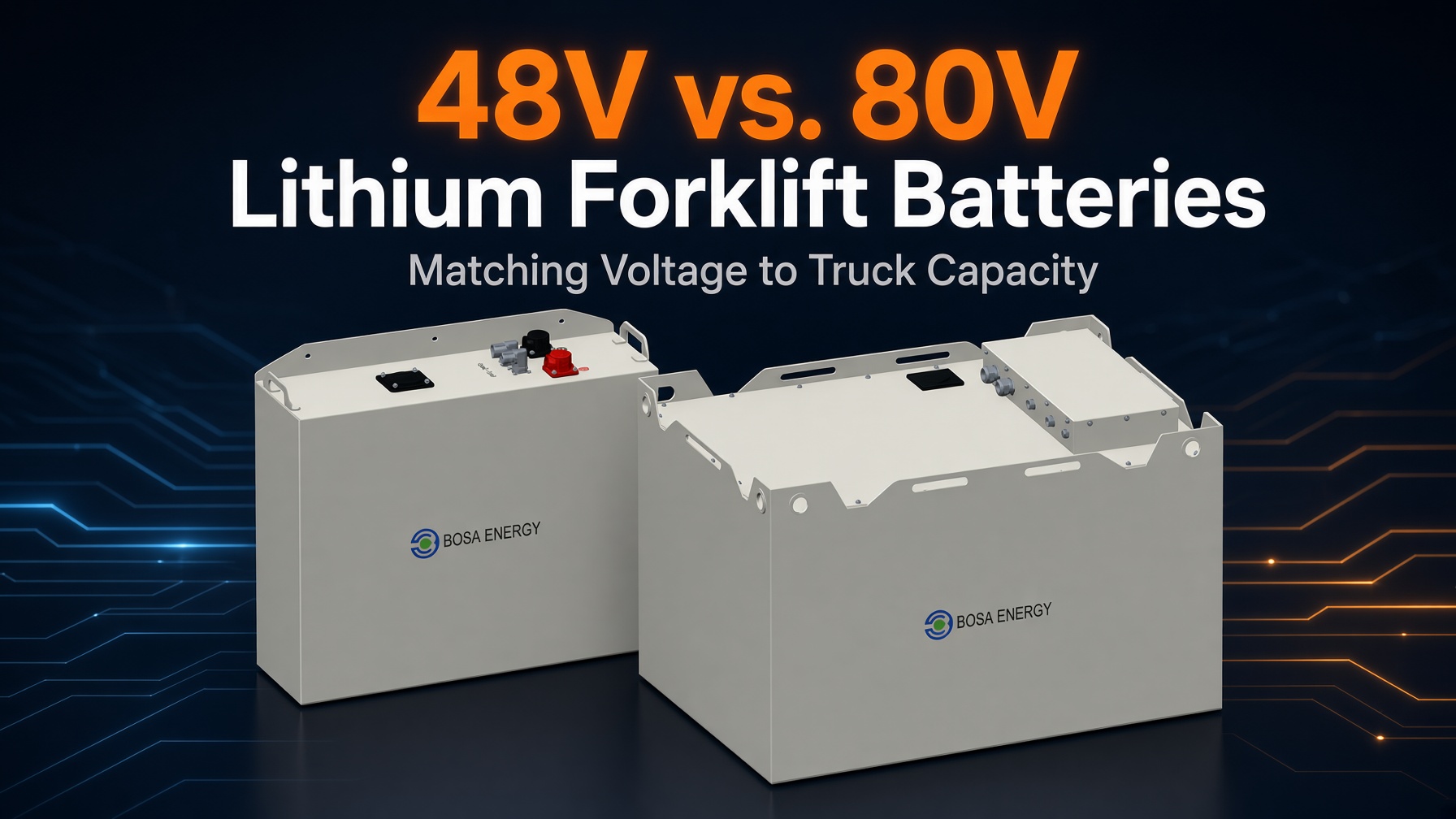
Selecting the right power source is critical for warehouse efficiency and long-term operational costs in material handling. 48V vs. 80V Lithium Forklift Batteries: Matching Voltage to Truck Capacity requires careful consideration of truck design, workload intensity, and energy demands. Voltage determines system compatibility and power delivery efficiency, while capacity measured in amp-hours or kilowatt-hours dictates runtime. Industry experts emphasize that the correct match maximizes productivity, reduces downtime, and lowers total cost of ownership.
Electric forklifts rely on precise voltage matching because motors, controllers, and hydraulic systems are engineered for specific nominal voltages. A mismatch can damage components, void warranties, or create safety hazards. Lithium iron phosphate (LiFePO4) chemistry has become the preferred upgrade over traditional lead-acid batteries due to superior cycle life, rapid charging, and maintenance-free operation. Both 48V and 80V systems benefit from these advantages, but the optimal choice depends on matching voltage to truck capacity and duty cycle.
Understanding Voltage and Capacity in Lithium Forklift Batteries
Voltage represents the electrical pressure that drives power to the traction motor and lift hydraulics. Power in watts equals voltage multiplied by current. For the same power output, a higher voltage system draws less current. Lower current reduces resistive heating losses calculated as current squared times resistance. This leads to cooler operation, higher sustained performance under heavy loads, and improved overall forklift battery energy efficiency.
Capacity, expressed in amp-hours, indicates how much charge the battery stores. Nominal energy in kilowatt-hours is calculated as voltage times amp-hours divided by one thousand. A 48V class lithium pack typically operates at 51.2V nominal, while an 80V class pack is around 83.2V. For example, a 51.2V 560Ah pack stores approximately 28.7 kWh, comparable in energy to certain 80V configurations with lower amp-hour ratings. Runtime depends on usable energy, depth of discharge, and actual power consumption during operation.
A 48V lithium forklift battery commonly serves medium-duty counterbalance trucks with capacities from three thousand to six thousand pounds. These systems excel in standard warehouse environments with moderate travel distances and lifting frequencies. In contrast, an 80V lithium forklift battery powers larger counterbalance trucks handling six thousand to twenty thousand pounds or more. Higher voltage supports intensive multi-shift operations in ports, steel mills, and heavy manufacturing where continuous high loads demand maximum acceleration and minimal heat buildup.
Key Differences Between 48V and 80V Systems
The primary distinction lies in current draw and thermal performance. An 80V system delivering the same mechanical power operates at significantly lower amperage than a 48V system. This reduces stress on cables, connectors, contactors, and the battery itself. Heat generation drops substantially, extending component life and maintaining consistent lift speeds even near the end of a shift. Lithium batteries in both voltages maintain a flat discharge curve, unlike lead-acid which sags under load, ensuring predictable performance throughout the duty cycle.
Compatibility is non-negotiable. A truck designed for 48V cannot accept an 80V battery without major modifications that are rarely practical or safe. Always verify the required voltage on the forklift data plate or in the manufacturer specifications. Typical capacity ranges for a 48V lithium forklift battery fall between four hundred and seven hundred amp-hours, while 80V packs often range from four hundred sixty to over one thousand amp-hours depending on the application. Chargers must match the voltage exactly; dedicated lithium chargers with appropriate CC/CV profiles are required for both.
Weight is another factor. Lithium packs are substantially lighter than equivalent lead-acid batteries. While this improves energy efficiency and maneuverability, forklifts use battery mass as part of the counterweight. Proper installation may require ballast plates to maintain stability when switching to lithium. Consult the truck manufacturer or a qualified technician to ensure compliance with stability standards.
Matching Voltage to Truck Capacity for Optimal Performance
Matching voltage to truck capacity begins with the original equipment manufacturer specification. Sit-down counterbalanced trucks in the three thousand to six thousand pound class typically use 48V systems. Larger models exceeding six thousand pounds, or those operating in high-throughput outdoor or heavy industrial settings, are engineered for 80V. Some reach trucks and specialized equipment may use either depending on mast height and load requirements. Real-world examples include certain Hyster or Toyota models that step from 48V on lower capacity variants to 80V on higher capacity configurations within the same series.
Beyond voltage, size the amp-hour capacity based on actual energy consumption. Measure average current draw during a representative shift or calculate required kilowatt-hours from workload data. Lithium batteries support high depth of discharge, often eighty percent or more, and opportunity charging during breaks. This allows smaller packs than lead-acid equivalents while maintaining or exceeding runtime. Multi-shift operations benefit most from lithium because rapid one to two hour charges eliminate the need for battery swaps and dedicated charging rooms.
Operational profile also matters. Indoor warehouse work with moderate intensity favors 48V for cost-effectiveness and wide availability. Outdoor yards, long travel distances, frequent heavy lifts, or continuous multi-shift duty cycles favor 80V for superior power delivery and reduced thermal stress. Always factor in charging infrastructure, available space, and total cost of ownership. Lithium systems typically achieve payback within a few years through reduced energy costs, eliminated maintenance, and higher productivity.
Advantages of Lithium Technology Across Both Voltages
LiFePO4 chemistry delivers three thousand to five thousand cycles compared to one thousand to fifteen hundred for lead-acid. Round-trip efficiency approaches ninety-five percent versus eighty to eighty-five percent. There is no watering, equalization, or acid handling. Integrated battery management systems provide cell balancing, overcurrent protection, thermal monitoring, and communication via CAN bus for fleet telemetry. These features apply equally to both voltage classes and enhance safety and reliability in lithium forklift battery systems.
Safety considerations include proper handling to avoid physical damage that could lead to thermal events. Charging areas should meet applicable standards for ventilation and fire protection. While OSHA powered industrial truck standards primarily address traditional batteries, best practices for lithium include using approved chargers, monitoring BMS alerts, and training personnel on emergency procedures. Regular inspections and following manufacturer guidelines minimize risks.
Practical Decision Framework
Start by confirming the truck voltage requirement. Next, analyze duty cycle hours, load weights, travel distances, and lift frequency. Calculate required usable energy and select capacity with a modest reserve for aging and peak demands. Evaluate compartment dimensions and weight specifications. Choose a reputable supplier offering integrated BMS, appropriate connectors, and compatible chargers. Consider total cost of ownership rather than upfront price alone. Pilot testing a lithium pack on a representative truck provides real data before full fleet conversion.
When properly matched, lithium upgrades transform material handling operations by increasing uptime, cutting energy use, and reducing labor associated with battery maintenance and swapping.
Часто задаваемые вопросы
What is the main rule for choosing between 48V and 80V lithium forklift batteries?
Always match the battery voltage to the forklift manufacturer specification listed on the data plate. Voltage is fixed by the design of the motors and controller.
Can an 80V lithium battery replace a 48V battery on the same truck?
No. The systems are not interchangeable. Using the wrong voltage risks equipment damage, safety issues, and warranty voidance.
How do I determine the right capacity for my operation?
Calculate nominal energy as voltage times amp-hours divided by one thousand, then size for your measured or estimated daily kilowatt-hour consumption considering depth of discharge and opportunity charging.
Are lithium batteries lighter and does that affect forklift stability?
Yes, lithium packs are significantly lighter. Additional counterweight may be needed to maintain rated capacity and stability. Verify with the truck manufacturer.
Which voltage offers better long-term value?
The correctly matched voltage for the specific truck and duty cycle provides the best value. Both deliver lithium advantages; 80V often suits heavier high-intensity applications while 48V serves standard warehouse needs efficiently.
Заключение
Choosing between these options comes down to precise alignment with equipment design and operational needs. 48V vs. 80V Lithium Forklift Batteries: Matching Voltage to Truck Capacity ensures optimal power delivery, efficiency, and reliability. A properly selected 48V lithium forklift battery or 80V lithium forklift battery within robust lithium forklift battery systems supports higher productivity and lower operating costs. Consult experts, verify specifications, and implement with attention to safety and total cost of ownership for the best results in your material handling fleet.