
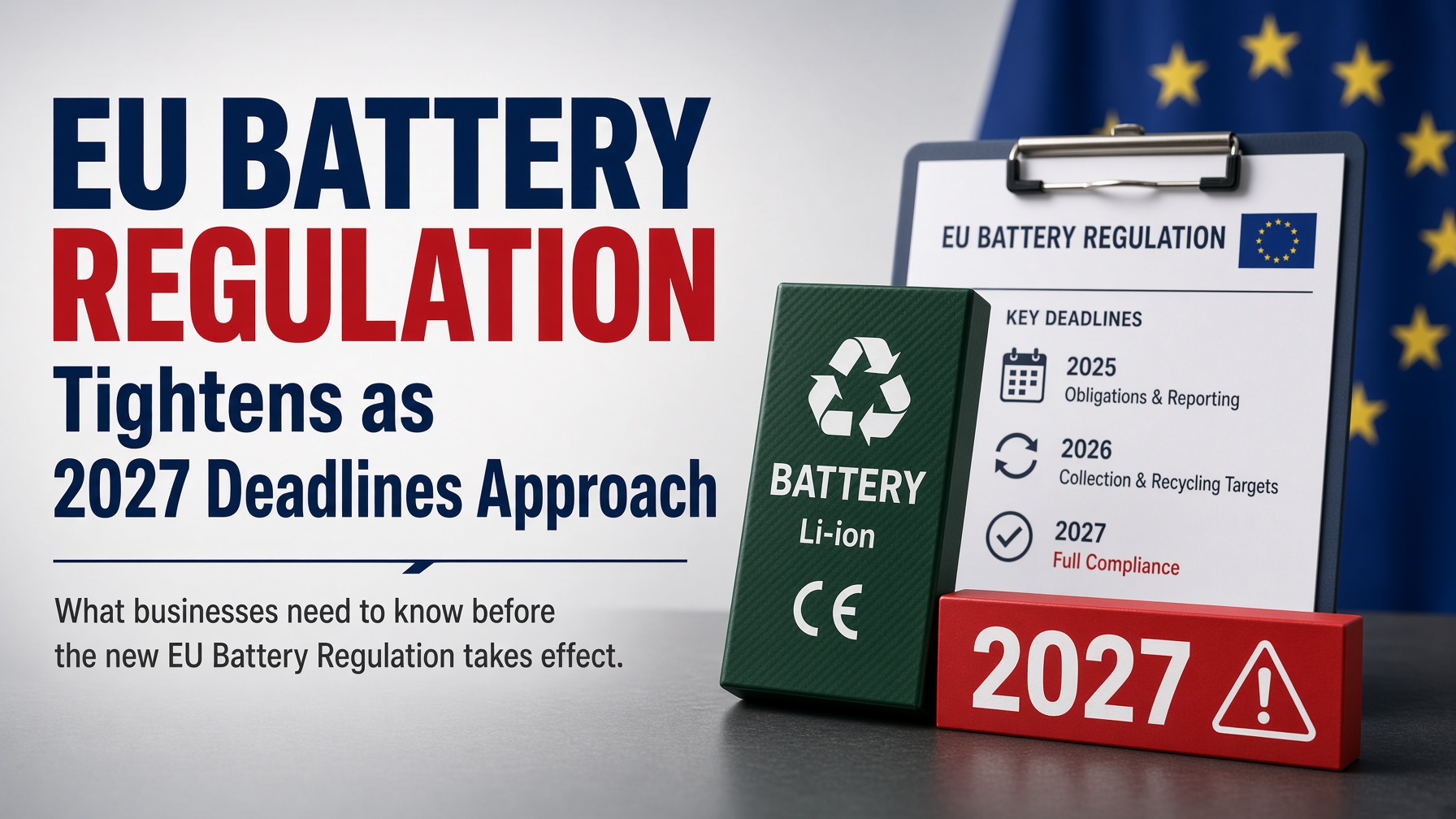
Europe’s Battery Regulation (EU 2023/1542) is moving into a more demanding phase for manufacturers and importers targeting the European market.
Key upcoming obligations include:
- From 18 February 2027: Mandatory QR codes on batteries and a digital battery passport for electric vehicle batteries, light means of transport (LMT) batteries, and industrial batteries above 2 kWh. The passport will contain data on composition, carbon footprint, recycled content, and history.
- From 18 August 2027: Supply-chain due diligence obligations covering cobalt, lithium, natural graphite, and nickel (postponed from 2025).
- From 18 August 2031: Minimum recycled-content requirements for certain batteries (e.g., 6% lithium, 6% nickel, 16% cobalt).
Material recovery targets are also rising: 50% lithium recovery by the end of 2027 and 80% by 2031, with even higher rates for cobalt, nickel, and other metals.
In parallel, the European Commission announced 46 new strategic raw-material projects (lithium, nickel, cobalt, manganese, graphite, and others) across multiple EU countries. These aim to meet Critical Raw Materials Act goals: at least 10% extraction, 40% processing, and 25% recycling of strategic materials within the EU by 2030. Officials have framed the effort as a response to supply-chain concentration risks.
For battery suppliers selling into Europe, compliance systems for the passport, due diligence, and recycled-content tracking are becoming near-term operational requirements rather than distant regulatory plans.
France and Germany Push for European Cars — With Limited Battery Local-Content Rules
France and Germany have outlined a joint position on the future of Europe’s automotive industry, aiming for cars of the future to be produced in Europe. However, the reported battery provisions are relatively modest.
According to reports, the approach would require only about 10% European content for batteries, while non-battery components would face a higher European-share requirement (around 70%). This sits below the share already achieved by European-made cells in early 2026 (roughly 48% of EV battery demand, according to Benchmark).
The position is being discussed alongside broader EU proposals, including a 90% CO₂ reduction target for new cars by 2035 and the Industrial Accelerator Act, which links public procurement and support for electric vehicles to Union origin—with batteries as a central element. European Parliament voting and further negotiations are expected in the coming weeks and months.
For non-European battery makers, the signals are mixed: Europe wants more local production and value chains, yet the current political compromise on battery content remains relatively low. Final rules will determine how much pressure is placed on Asian suppliers versus European cell makers.
Stellantis to Switch Many European EVs from NMC to LFP Batteries
Stellantis plans to move many of its electric vehicles sold in Europe from nickel-manganese-cobalt (NMC) batteries to lower-cost lithium-iron-phosphate (LFP) cells starting in 2027.
CEO Antonio Filosa said on the company’s third-quarter earnings call that the chemistry switch represents a substantial saving in battery cost. Stellantis already uses LFP in some models (for example, cells supplied by SVOLT for the Citroën ë-C3). The move is part of broader efforts to improve the economics of electric vehicles in the region amid cost pressures and competition.
Other European automakers are also increasing LFP adoption for more affordable models. The shift reflects a wider industry trend: LFP’s cost advantage is outweighing its lower energy density for volume segments in Europe, while higher-performance models continue to use NMC or other advanced chemistries.
CATL Expands Sodium-Ion Storage Push with European Partners
CATL is accelerating sodium-ion energy storage deployment in Europe through new partnerships with local companies.
The company signed a memorandum of understanding with German storage provider Intilion to deploy 3 GWh of sodium-ion systems (Tener Sodium) in markets including Germany, Switzerland, and Austria over five years. The systems are designed for European winter conditions, with claimed cycle life exceeding 15,000 cycles, a 25-year operational lifespan, and strong performance at –20°C.
This follows earlier European sodium-ion agreements, including a 5 GWh deal with Dutch integrator Alfen (starting from 2027) and other partnerships. CATL positions sodium-ion as a complement to lithium-ion—particularly attractive for stationary storage where extreme temperatures or reduced lithium-price exposure matter more than maximum energy density.
European utilities, developers, and commercial & industrial customers are the primary targets for these systems.
Samsung SDI Wins First European LFP EV Battery Order
Samsung SDI has secured its first project to supply LFP batteries for electric vehicles in Europe, according to statements on its third-quarter earnings call.
The company said the deal is based on the competitiveness of its prismatic and cylindrical LFP products. While the specific customer and volume were not disclosed, the order marks a notable expansion for Samsung SDI into the European volume EV segment with LFP chemistry. Management also noted recovering demand in the European EV market, supported by high oil prices and subsidies, particularly for volume models.
In parallel, Samsung SDI has booked more than 60 GWh of energy-storage system orders so far in 2026, though many of those are for non-European markets.
EU Innovation Fund Backs LFP Factories in Spain and Poland
The European Commission selected several battery-related projects under its Innovation Fund, including LFP cell manufacturing capacity in Europe.
Notable selections include:
- PowerCo’s planned LFP battery cell gigafactory in Sagunto (Valencia), Spain, with up to 27 GWh of capacity (part of a larger planned site).
- LG Energy Solution Wrocław’s ArisEU project to establish an LFP battery cell production line in Poland with 9 GWh annual capacity.
These projects sit alongside broader EU efforts (including the Battery Booster Facility, which can mobilise up to €1.5 billion from ETS revenues to support cell production ramp-up in the European Economic Area). The funding aims to increase European cell manufacturing capacity, with a particular focus on cost-competitive LFP chemistry suited to volume EVs and storage.