
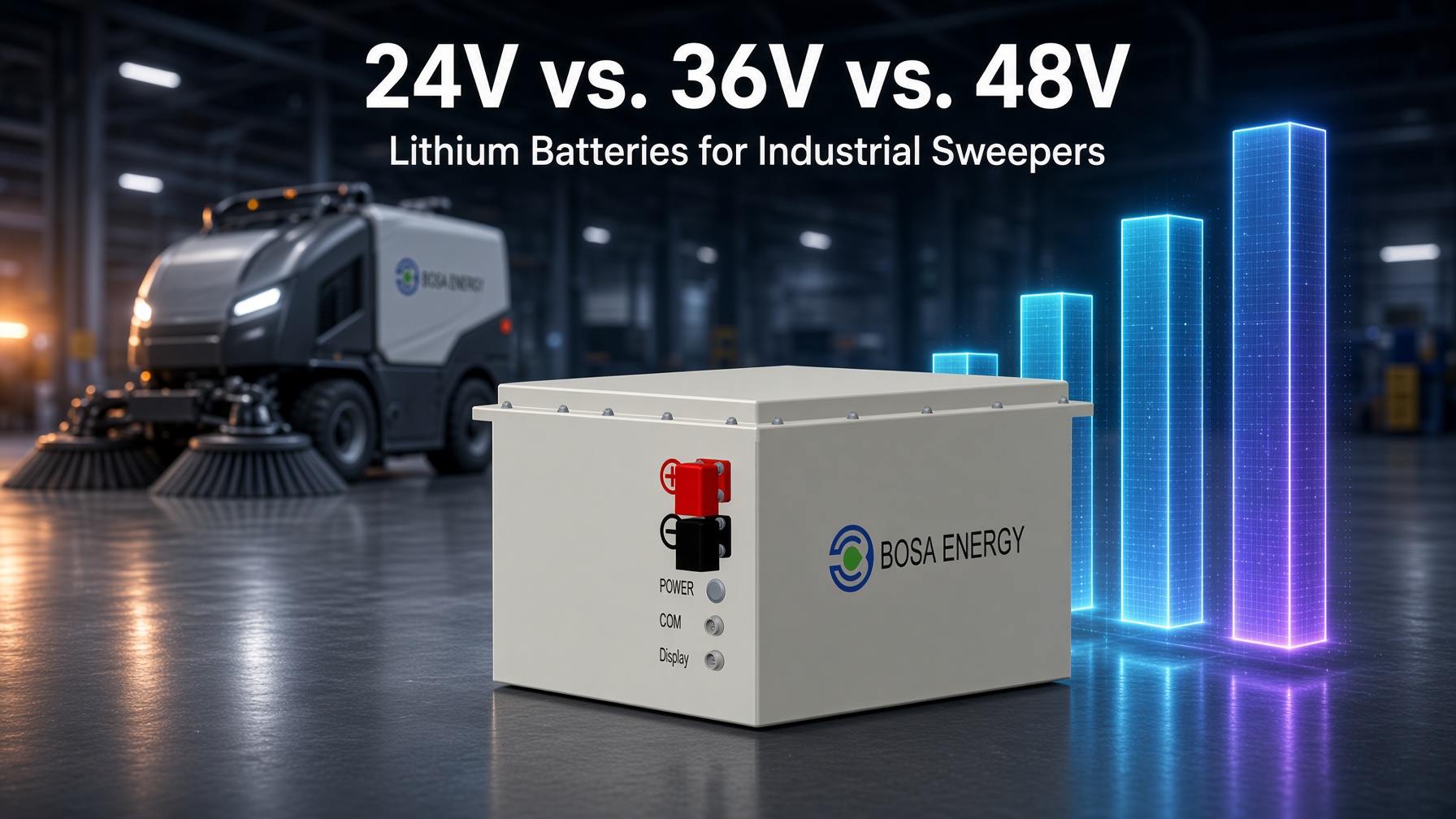
Selecting the right battery voltage is one of the most important decisions when powering industrial floor sweepers. The title of this guide, 24V vs. 36V vs. 48V Lithium Batteries for Industrial Sweepers, captures a practical question facility managers and equipment operators face every day. Industrial sweepers must deliver reliable runtime, consistent brush performance, and low downtime across warehouses, factories, logistics centers, and large commercial spaces. Lithium iron phosphate (LiFePO4) batte ries have become the preferred chemistry because they offer 2,000–5,000+ cycles, zero routine maintenance, fast opportunity charging, and stable voltage output throughout the discharge cycle.
A 24V lithium battery for industrial sweepers suits compact walk-behind or smaller ride-on units. A 36V LiFePO4 battery for mid-size ride-on sweepers balances power and efficiency for medium-area cleaning. A 48V lithium battery system for heavy-duty industrial sweepers supplies the torque and endurance required for large-scale operations. Matching voltage to the machine’s motor controller and duty cycle prevents underperformance, excessive current draw, heat buildup, and unnecessary cost.
Why Voltage Matters for Industrial Sweepers
Voltage determines how power reaches the traction motors, main brushes, side brushes, and vacuum or dust-control systems. Power (watts) equals voltage multiplied by current. At higher voltage, the same power is delivered with lower amperage. Lower current reduces resistive losses (P_{\text{loss}} = I^2 R), keeps wiring and connectors cooler, and improves overall efficiency. LiFePO4 cells have a nominal voltage of 3.2 V, so common pack configurations are:
- 24 V class ≈ 25.6 V nominal (8S)
- 36 V class ≈ 38.4 V nominal (12S)
- 48 V class ≈ 51.2 V nominal (16S)
Always match the battery voltage exactly to the machine’s rated system. A mismatch can damage the controller or reduce performance. Capacity (Ah) then determines runtime once the correct voltage is chosen. Usable energy is also higher with lithium because typical daily depth of discharge is 80–100 % versus roughly 50 % for flooded lead-acid.
24V Lithium Batteries for Compact and Walk-Behind Sweepers
A 24V lithium battery for industrial sweepers is the standard choice for walk-behind units and smaller ride-on sweepers used in retail, offices, hospitals, and light industrial settings. These packs commonly range from 50 Ah to 150 Ah (roughly 1.3–3.8 kWh). The lower voltage keeps the battery compact and lightweight, which preserves maneuverability and reduces operator fatigue on walk-behind machines.
Typical real-world runtime for a well-matched 24 V 100 Ah LiFePO4 pack is 3–5 hours under normal sweeping conditions, depending on brush pressure, floor type, and speed. Because lithium maintains high voltage until near the end of discharge, brush RPM and cleaning performance stay consistent. Charging is usually complete in 2–4 hours, and opportunity charging during breaks is fully supported without harming cycle life. Weight savings versus lead-acid can exceed 50 %, which is valuable on machines that are frequently moved or stored in tight spaces.
Limitations appear on larger machines or continuous multi-shift work: current draw rises, heat increases, and runtime may fall short without a larger capacity pack. For these applications, moving to 36 V or 48 V is usually more efficient.
36V LiFePO4 Batteries for Mid-Size Ride-On Sweepers
De 36V LiFePO4 battery for mid-size ride-on sweepers occupies the practical middle ground. Capacities typically run 100–200 Ah or more (approximately 3.8–7.7 kWh). This voltage provides higher motor efficiency and lower current for the same power compared with 24 V, which improves thermal behavior and allows longer continuous operation in retail warehouses, airports, and medium factories.
Operators commonly see 4–7 hours of runtime on a single charge, with the ability to top up during lunch or shift changes. The reduced amperage also eases the load on cables and connectors. Many mid-size industrial sweepers from major manufacturers are designed around 36 V systems, making drop-in or near-drop-in lithium replacements straightforward when the physical dimensions and communication interfaces match.
48V Lithium Battery Systems for Heavy-Duty Industrial Sweepers
A 48V lithium battery system for heavy-duty industrial sweepers is engineered for large ride-on machines that cover extensive areas, climb ramps, and operate for full or multi-shift periods. Packs often start at 150–200 Ah and can exceed 300–400 Ah (roughly 7.7–20+ kWh). The higher voltage delivers strong torque while keeping current moderate, which is critical for sustained high-power brushing and dust collection on rough or debris-heavy floors.
Runtime on a properly sized 48 V pack frequently reaches 5–8+ hours. Fast charging and opportunity charging support high-utilization fleets. Because current is lower than an equivalent-power 24 V or 36 V system, wiring losses and heat generation decrease, which supports reliability in demanding environments such as manufacturing plants and large logistics hubs. These systems also benefit from robust BMS features, including cell balancing, temperature monitoring, and communication protocols (CAN, RS485) for integration with machine controllers.
Side-by-Side Comparison
| Aspect | 24V LiFePO4 | 36V LiFePO4 | 48V LiFePO4 |
|---|---|---|---|
| Typical machine | Walk-behind / small ride-on | Mid-size ride-on | Heavy-duty large ride-on |
| Common capacity | 50–150 Ah | 100–200 Ah | 150–400+ Ah |
| Energy range | ~1.3–3.8 kWh | ~3.8–7.7 kWh | ~7.7–20+ kWh |
| Current for same power | Highest | Medium | Lowest |
| Best use case | Compact areas, light duty | Medium warehouses, retail | Large plants, multi-shift |
| Weight advantage | Excellent | Strong | Good (higher capacity offsets) |
| Typical runtime | 3–5 hours | 4–7 hours | 5–8+ hours |
De LiFePO4 battery voltage comparison for floor cleaning equipment shows that higher voltage improves efficiency under load, while capacity sets the absolute energy available. Total cost of ownership favors lithium across all voltages because cycle life is typically 5–10 times longer than lead-acid, maintenance is eliminated, and charging downtime shrinks dramatically.
Key Advantages of Lithium over Lead-Acid for Sweepers
Maintenance-free lithium batteries for commercial sweepers remove the need for watering, equalization charges, and acid-related corrosion. Voltage remains stable, so cleaning performance does not degrade as the battery discharges. Energy efficiency is typically 95 % versus 75–85 % for lead-acid. Opportunity charging is safe and extends usable shift coverage. Safety features in modern BMS units include over-current, over-temperature, short-circuit, and low-temperature protection. LiFePO4 chemistry is inherently more stable than other lithium types.
How to Choose the Right Voltage
- Confirm the machine’s rated voltage and controller specifications.
- Calculate required energy: estimate average power draw (watts) × desired runtime (hours), then select capacity with usable depth of discharge in mind.
- Verify physical fit, weight distribution, and connector compatibility.
- Ensure the charger matches the voltage and supports the recommended charge profile.
- Check communication and BMS integration if the machine uses smart features.
- Evaluate total cost of ownership over 5–8 years rather than initial price alone.
For new equipment, specify lithium from the factory when possible. For upgrades, consult the machine manufacturer or a qualified battery supplier to confirm compatibility.
Practical Selection Guidance and Real-World Considerations
In practice, many facilities operate mixed fleets. Walk-behind units stay on 24 V for simplicity and lower cost. Mid-size machines move to 36 V for better efficiency. Large industrial sweepers adopt 48 V to handle continuous heavy use and minimize electrical losses. Cold environments may require BMS with thermal management or heated packs to maintain capacity. High ambient temperatures demand good ventilation and proper BMS settings. Always follow the manufacturer’s recommended depth of discharge and charge limits to maximize life.
Regular monitoring of state of charge, cell balance, and temperature through the BMS or machine display helps prevent unexpected downtime. Proper storage (partial charge, moderate temperature) further extends calendar life.
Veelgestelde vragen
What is the best voltage for an industrial sweeper? It depends on machine size and duty. 24 V for compact units, 36 V for mid-size ride-ons, and 48 V for heavy-duty large machines. Always match the existing system voltage.
How long do LiFePO4 batteries last in sweepers? Typically 2,000–5,000+ cycles or 5–10 years under normal commercial use, far exceeding lead-acid.
Can I opportunity charge lithium batteries? Yes. Partial charges during breaks are fully supported and do not reduce cycle life.
Will a higher voltage battery improve runtime? Only if capacity (Ah) is also appropriate. Higher voltage mainly improves efficiency and reduces current for the same power.
Is special maintenance required? No routine maintenance is needed. Periodic visual inspection and BMS data review are sufficient.
Conclusie
The comparison 24V vs. 36V vs. 48V Lithium Batteries for Industrial Sweepers demonstrates that the correct voltage, paired with adequate capacity and a quality LiFePO4 pack, delivers longer runtime, consistent performance, lower operating costs, and higher uptime. Choosing based on machine requirements and actual duty cycle ensures reliable cleaning across industrial environments. Lithium technology has matured into a practical, high-return solution for professional floor-care fleets.