
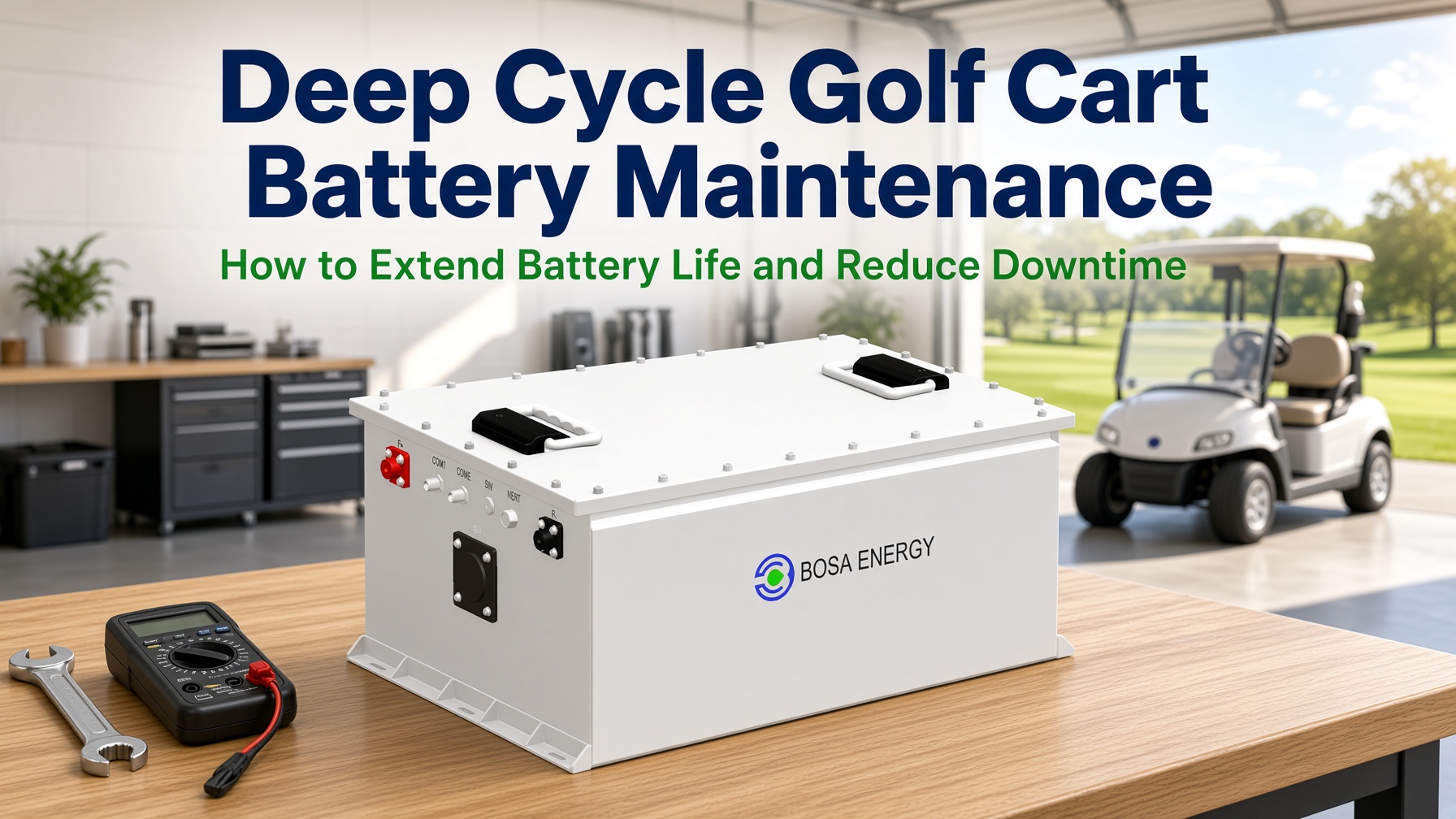
Deep Cycle Golf Cart Battery Maintenance: How to Extend Battery Life and Reduce Downtime is essential for every golf cart owner who wants reliable performance season after season. Whether you operate a fleet of carts on a golf course or enjoy weekend rounds on a private course, battery health directly impacts uptime, range, and total cost of ownership. Deep cycle batteries are designed for repeated discharge and recharge cycles, but poor habits can cut their useful life in half and lead to unexpected downtime.
Modern lithium iron phosphate (LiFePO4) packs have transformed the industry by offering far longer cycle life and lower day-to-day upkeep than traditional flooded lead-acid batteries. Even so, they are not completely maintenance-free. Following proven deep cycle golf cart battery maintenance practices protects your investment, maximizes usable capacity, and keeps carts on the course instead of in the shop.
Why Proper Care Matters for Deep Cycle Batteries
Deep cycle golf cart batteries experience partial to full discharges on a regular basis. Lead-acid batteries typically deliver 500–1,000 cycles when properly maintained, while quality LiFePO4 packs routinely reach 2,000–5,000+ cycles. The difference comes down to chemistry and care. Sulfation, plate corrosion, and water loss plague flooded lead-acid batteries if equalization charges and watering are neglected. Lithium cells, by contrast, suffer mainly from extreme temperatures, incorrect charge voltage, and prolonged storage at 100% state of charge.
Owners who implement consistent how to extend lithium golf cart battery life strategies routinely see batteries last 8–12 years or more. The same disciplined approach also reduces downtime: fewer emergency replacements, fewer mid-round failures, and lower labor costs for fleet operators.
Routine Inspection and Terminal Care
Start with a visual inspection every 30–60 days. Look for loose cables, cracked cases, corrosion (common on lead-acid), or any signs of swelling or heat damage. Tighten connections to the manufacturer’s torque specifications and apply a thin film of dielectric grease or anti-corrosion spray on exposed terminals.
Lithium packs require far less terminal maintenance because they are sealed and produce no acid fumes. Still, verify that all high-current connections remain clean and tight. A loose cable can create resistance, heat, and voltage drop that shortens life and creates safety risks. If your pack includes a Bluetooth BMS, review cell voltages and temperatures periodically; balanced cells and consistent temperatures are signs of a healthy system.
Charging Best Practices That Protect Capacity
Correct charging is the single most effective way to extend battery life. Always use a charger matched to the battery chemistry. A lead-acid charger left connected to a lithium pack can overcharge cells once the BMS opens, while a lithium-specific charger on a lead-acid bank will undercharge and promote sulfation.
For LiFePO4 golf cart batteries:
- Charge after use whenever practical. Opportunity charging does not harm lithium chemistry.
- Never charge when the pack temperature is below 32°F (0°C). Charging in freezing conditions causes lithium plating and permanent capacity loss.
- Allow the charger to complete its cycle so the BMS can balance cells.
- Avoid leaving the pack at 100% state of charge for weeks or months.
Diese proper charging practices for deep cycle golf cart batteries prevent the most common capacity fade mechanisms and keep voltage sag minimal under load.
Depth of Discharge and Daily Use Habits
Lead-acid batteries lose life rapidly if regularly discharged below 50% state of charge. Lithium packs tolerate deeper discharges, but staying above 20% state of charge still maximizes longevity. Many owners find that limiting daily use to the middle 40–80% of capacity, then topping up as needed, produces the longest service life.
Avoid running any deep cycle battery to the point of BMS cutoff on a regular basis. Repeated full discharges stress cells and increase the chance of imbalance. If your cart frequently returns with low charge, either shorten routes, add a mid-day opportunity charge, or upgrade to a higher-capacity lithium pack.
Seasonal Storage and Winter Care
Storage is where many batteries fail prematurely. Flooded lead-acid batteries should be stored fully charged and recharged every 4–6 weeks to prevent sulfation and freezing. Lithium batteries prefer a moderate state of charge.
Recommended lithium golf cart battery winter storage procedure:
- Discharge or charge the pack to approximately 40–60% state of charge.
- Disconnect the main power (or place the cart in tow mode and switch the battery off if equipped).
- Store in a cool, dry location above freezing if possible.
- Check state of charge every 2–3 months and top up if it drifts below 30%.
A pack left at 100% for an entire off-season ages faster than one stored at mid-charge. Conversely, a lithium pack left completely flat for months can enter a deep-discharge state that is difficult or impossible for the BMS to recover.
Temperature Management and Environmental Factors
Heat accelerates chemical aging in both lead-acid and lithium batteries. Parking carts in direct sun or in poorly ventilated battery compartments raises internal temperatures and shortens calendar life. Cold weather reduces available capacity temporarily; lithium recovers fully once warmed, but charging must still be avoided below freezing.
Good airflow around the battery pack, shade when parked, and avoiding prolonged exposure above 100°F (38°C) are simple steps that deliver measurable life extension.
Troubleshooting and Reducing Downtime
Common causes of unexpected downtime include:
- Loose or corroded connections
- Charger mismatch or failed charger
- BMS protective shutdown (over-temperature, over-discharge, or cell imbalance)
- Watered lead-acid batteries that have dried out
When a cart fails to start or shows reduced range, begin with a voltage check under load and a visual inspection. For lithium systems, connect to the BMS app to read fault codes rather than guessing. Keeping a spare charger, a set of cleaned terminals, and basic tools on hand allows many issues to be resolved in minutes rather than hours.
Systematic reducing golf cart battery downtime comes from preventive habits rather than reactive repairs. Fleets that log charge cycles, monitor temperature trends, and schedule quarterly inspections experience far fewer mid-season failures.
Advantages of Upgrading to Lithium Deep Cycle Packs
Many owners still running lead-acid banks discover that the switch to a properly sized LiFePO4 pack eliminates most traditional maintenance. There is no watering, no equalization, no acid corrosion, and significantly less weight. Faster charging and higher usable capacity further reduce the number of times a cart must sit idle. When combined with the maintenance practices outlined above, lithium packs deliver the lowest total cost of ownership for both recreational and commercial users.
Deep Cycle Golf Cart Battery Maintenance: How to Extend Battery Life and Reduce Downtime ultimately comes down to matching the right chemistry with the right habits. Whether you stay with lead-acid or move to lithium, consistent attention to charging, storage state of charge, temperature, and connections will keep your carts running longer and with fewer interruptions.
Häufig gestellte Fragen
How often should I charge a lithium golf cart battery? Charge after use or whenever convenient. Unlike lead-acid, lithium does not suffer from partial charges. Just avoid leaving it at 100% for long periods and never charge below freezing.
Can I leave my lithium golf cart plugged in all winter? No. Store at roughly 40–60% state of charge, disconnect or switch off the battery, and top up every couple of months if needed.
Do lithium golf cart batteries need watering or equalization? No. They are sealed and the BMS handles cell balancing. Watering and equalization are lead-acid practices only.
What is the ideal depth of discharge for longest life? Stay above 20% for lithium and above 50% for lead-acid. Operating in the middle of the pack most days further extends cycle life.
Why does my lithium pack show reduced range in cold weather? Cold temperatures temporarily lower available capacity. The pack recovers when it warms up. Never charge it while it is below 32°F.
How long do well-maintained deep cycle golf cart batteries last? Flooded lead-acid batteries typically last 2–5 years. Quality LiFePO4 packs commonly last 8–12+ years or 2,000–5,000 cycles with proper care.