
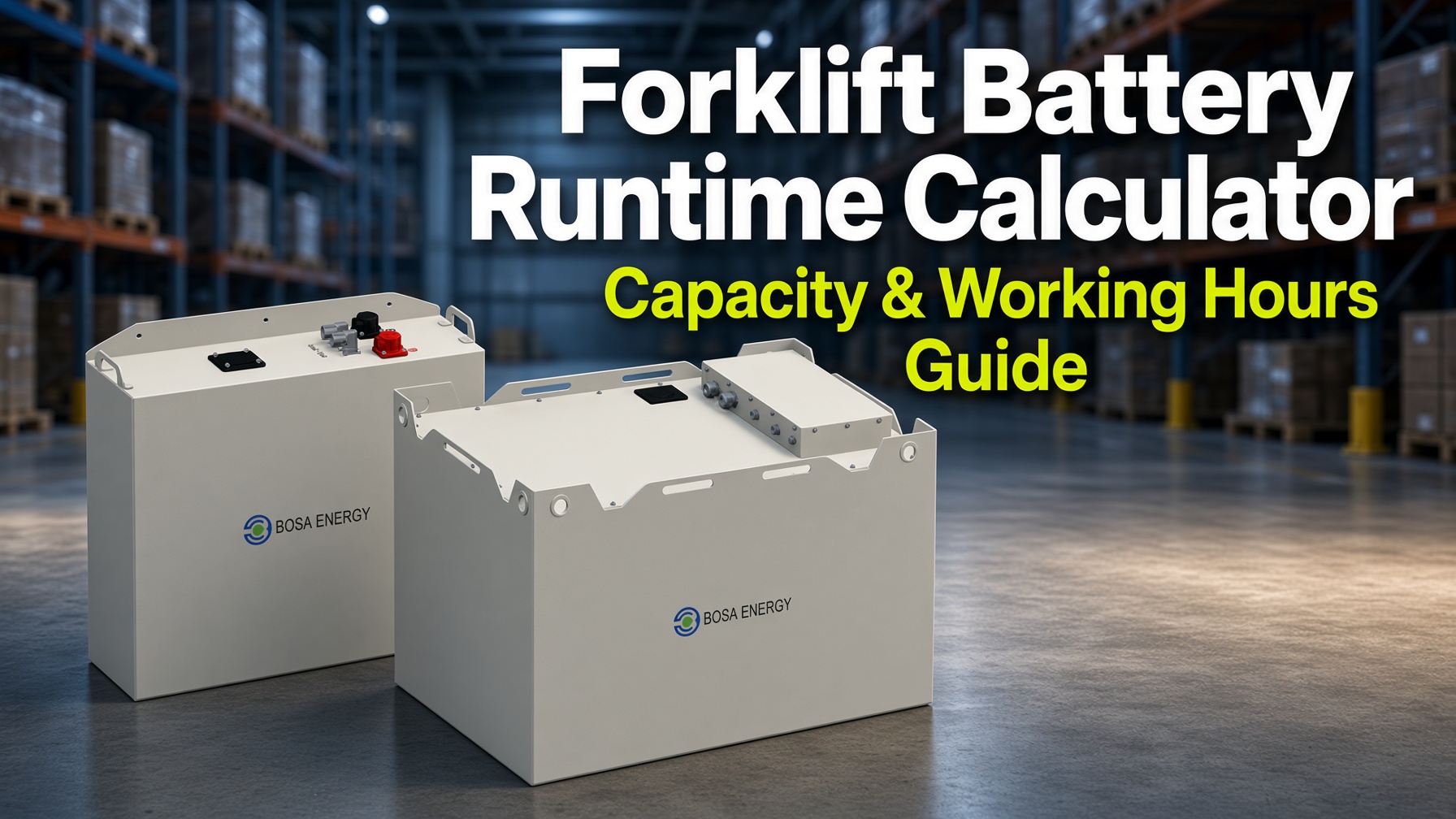
Accurate planning of electric forklift operations starts with knowing exactly how long a battery will last under real working conditions. The Forklift Battery Runtime Calculator: Capacity & Working Hours Guide provides fleet managers, warehouse operators, and maintenance teams with a practical method to convert rated battery capacity into expected working hours. Whether you run a single-shift distribution center or a multi-shift manufacturing facility, understanding the relationship between capacity, depth of discharge, average current draw, and duty cycle prevents unexpected downtime and helps size the right lithium battery pack.
Lithium iron phosphate (LiFePO4) batteries have changed the calculation compared with traditional lead-acid packs. Higher usable capacity, stable voltage, and the ability to opportunity-charge during breaks mean that a properly sized lithium pack often delivers longer effective working hours per calendar day even when the nameplate amp-hour rating is lower. This guide walks through the formulas, the variables that matter most, and how to use a forklift battery runtime calculator for reliable results.
Understanding Capacity and Energy in Forklift Batteries
Battery capacity is expressed in amp-hours (Ah) at a given nominal voltage. Energy in kilowatt-hours is calculated as:
kWh = (Voltage × Ah) / 1000
A common 48 V 600 Ah lithium pack stores 28.8 kWh of nominal energy. Not all of that energy is usable. Depth of discharge for forklift batteries is typically limited to 80–90 % for LiFePO4 to balance runtime with cycle life, while lead-acid is often restricted to 50–60 % to avoid sulfation. System efficiency (battery, controller, and motor) further reduces the energy that reaches the wheels and lift hydraulics. Lithium systems commonly achieve 90–95 % round-trip efficiency; lead-acid systems are often 75–85 %.

Lithium forklift battery capacity therefore delivers more usable energy from a smaller or similar nameplate rating. This is why many operators replace a 48 V 750 Ah lead-acid pack with a 48 V 500–600 Ah lithium pack and still cover the same or longer shifts.
Core Runtime Formulas
Two equivalent methods are used depending on whether you have amp data or power data.
Amp-hour method Runtime (hours) = (Rated Ah × Usable DoD × Efficiency) ÷ Average current draw (A)
Energy method Runtime (hours) = Usable kWh ÷ Average power draw (kW)
Example: 48 V 560 Ah lithium pack, 90 % DoD, 95 % efficiency, average draw 80 A. Usable Ah = 560 × 0.90 × 0.95 ≈ 479 Ah Runtime ≈ 479 / 80 ≈ 6.0 hours of active operation.
If the same truck draws an average of 4 kW, usable energy is roughly 48 × 560 × 0.90 × 0.95 / 1000 ≈ 22.9 kWh, giving about 5.7 hours. The two methods should agree within measurement tolerances. Always apply a 10–20 % safety margin for temperature, aging, and unexpected heavy lifts.
Factors That Change Real Working Hours
Duty cycle is the percentage of the shift during which the truck is actually moving or lifting. Dedicated high-throughput trucks may run at 60–70 % duty cycle; shared trucks in lighter operations may be closer to 25–40 %. A forklift battery runtime calculator that ignores duty cycle will overstate available hours.
Load weight, lift height, travel distance, floor condition, and operator behavior all affect average current. Cold storage below 0 °C can increase energy consumption by 20–40 % and temporarily reduce available capacity. Lithium batteries recover quickly once they warm, but sizing should still include a cold-weather buffer if the facility operates in refrigerated zones.
Opportunity charging is the largest practical advantage of lithium. A 15–30 minute top-up during lunch or breaks can restore 20–40 % of capacity at high charge rates, effectively extending daily working hours without a full battery swap. Lead-acid packs cannot accept partial charges without damaging cycle life, so multi-shift operations historically required spare batteries and change-out rooms.

How to Use a Forklift Battery Runtime Calculator
Collect three pieces of field data before using any calculator:
- Average current draw measured with a clamp meter or the truck’s own diagnostics over a representative shift.
- Actual duty cycle (active time ÷ total shift time).
- Required continuous working hours plus any planned opportunity-charge windows.
Enter rated Ah, voltage, target DoD, and efficiency. The calculator returns expected runtime and the minimum capacity needed to cover the shift. Compare lithium and lead-acid side by side; the lithium result will normally show fewer amp-hours required for the same usable energy because of higher DoD and efficiency.
ال Forklift Battery Runtime Calculator: Capacity & Working Hours Guide emphasizes that nameplate ratings alone are insufficient. Validate the calculator output with a one- or two-day field trial after installation. Monitor state-of-charge via the battery management system and adjust future sizing if real-world consumption differs by more than 10 %.
Practical Sizing Examples
| Scenario | الجهد االكهربى | Target Hours | Recommended Lithium Ah | ملحوظات |
|---|---|---|---|---|
| Light warehouse, single 8 h shift | 48 V | 6–7 active | 400–500 Ah | Opportunity charge optional |
| Medium distribution, 8–10 h | 48 V | 7–8 active | 550–700 Ah | One short opportunity charge |
| Heavy multi-shift manufacturing | 80 فولت | Continuous with breaks | 600–900 Ah | Multiple opportunity charges |
| Cold storage reach truck | 36–48 V | 6 h | +20 % capacity | Temperature derate applied |
These ranges assume modern LiFePO4 chemistry, proper BMS, and average industrial duty cycles. Always confirm voltage and connector compatibility with the specific forklift model.
Lithium Advantages for Runtime and Total Cost
Higher usable capacity, fast charging, and elimination of battery changes reduce both labor and equipment inventory. A lithium pack that supports opportunity charging can often replace two or three lead-acid packs in multi-shift service while delivering consistent power down to low state-of-charge. Cycle life of 3 000–5 000+ cycles further lowers the cost per working hour over a 7–10 year period.
الأسئلة الشائعة
How do I calculate forklift battery working hours from amp-hours? Divide usable amp-hours (rated Ah × DoD × efficiency) by the measured average current draw in amps. Include duty cycle if the average was taken only during active periods.
What is a realistic depth of discharge for lithium forklift batteries? 80–90 % is common. Staying at or below 80 % maximizes cycle life while still providing substantially more usable energy than lead-acid at 50 %.
Why does my forklift battery runtime calculator give different results from the nameplate? Nameplate Ah assumes a specific discharge rate and full capacity. Real-world temperature, aging, high discharge rates, and accessory loads reduce available runtime. Always use field-measured current.
Can opportunity charging extend working hours enough to eliminate a second battery? Yes for most single- and double-shift operations. A properly sized lithium pack plus two short opportunity charges typically covers 16+ hours of daily operation.
Does voltage affect runtime calculations? Yes. Higher-voltage systems (80 V, 96 V) store more energy for the same Ah rating and are common on larger trucks. Always calculate energy in kWh when comparing different voltages.
Related Links
- Lithium Forklift Battery Charging Best Practices
- How to Choose the Right LiFePO4 Capacity for Your Fleet
- Opportunity Charging vs Battery Swapping: Cost Comparison
- Cold Storage Performance of Lithium Forklift Batteries
- Forklift Battery Maintenance Checklist for Lithium Packs
هذا Forklift Battery Runtime Calculator: Capacity & Working Hours Guide equips you to size packs with confidence, minimize downtime, and capture the full productivity benefit of lithium technology in daily warehouse operations.