
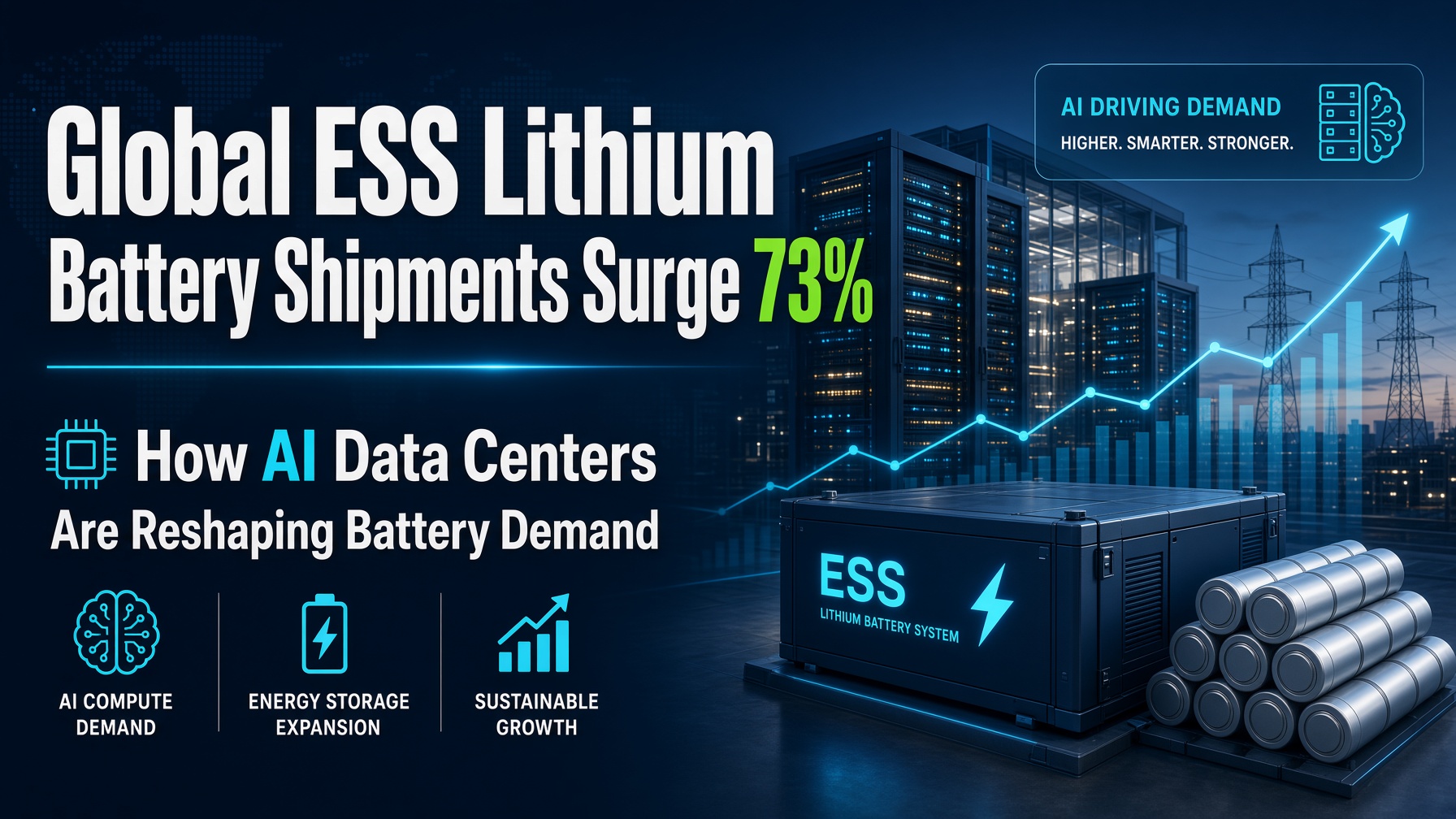
On November 5, 2026, market research firm SNE Research released its latest figures: global lithium-ion battery shipments for energy storage systems (ESS) reached 779.9 GWh in the first three quarters of 2026, up 73% from 451.5 GWh in the same period last year. Third-quarter shipments alone hit a record 286.8 GWh, rising 58% year-on-year and 7% quarter-on-quarter. The data makes one thing clear — energy storage has become the strongest growth driver in the lithium battery industry, powered primarily by the surging electricity needs of artificial intelligence data centers.
Growth Shifts Beyond China
China remained the largest single market with 313.1 GWh shipped, but its share of the global total fell to 40.1% from 48.9% a year earlier. Shipments outside China totaled 466.8 GWh, accounting for 59.9% of the global total — up from 57.3% in the first half.
Regional highlights include:
- North America: 122.3 GWh, up 71%
- Europe: 131.2 GWh, up 87%
- Middle East, Asia ex-China, and Australia: triple-digit growth rates of 157%, 153%, and 113% respectively
The center of gravity is clearly moving. Overseas markets, particularly North America and Europe, are now the main engines of global growth.
By application, grid-scale storage still dominates with 575.9 GWh (roughly 73.8% of the total). Residential storage grew the fastest, rising 152% to 97.5 GWh, while commercial and industrial storage increased 57% to 62.2 GWh.
Supplier Landscape: China Leads, Korea Gains in North America
Chinese manufacturers held the top three positions:
- CATL led with 198.3 GWh and a 25.4% global market share
- Hithium ranked second with 75.7 GWh
- EVE Energy placed third with 71.6 GWh
Together, the three Chinese firms captured 44.3% of global ESS battery shipments.
Korean players made notable gains in North America. LG Energy Solution shipped 22.1 GWh globally in the first nine months (up 355%), including 18.4 GWh in North America, lifting its regional share from 4.8% to 15.0%. In the third quarter, LG Energy Solution overtook Hithium to become the second-largest ESS battery supplier in North America behind CATL. Samsung SDI grew 46% to 12.0 GWh globally, with its AI data-center-related shipments rising 68%. The combined North American share of the two Korean companies reached 20.9%.
The AI Data Center Driver
SNE Research identified the rapid expansion of AI data centers as the primary force behind the shipment surge. Training and inference workloads require large volumes of stable, high-power electricity. With renewable energy penetration rising and grid flexibility remaining limited, large-scale battery storage has become essential infrastructure rather than a supporting technology.
At the same time, many countries are accelerating renewable integration, further increasing demand for both short-duration and longer-duration storage. The lithium battery market is shifting from being predominantly driven by electric vehicles to a more balanced mix of EVs and energy storage.
Implications and Outlook
The ESS boom is reshaping order patterns across the upstream chain — lithium salts, cathode materials, and cells. Several material producers have indicated that high-compaction-density LFP products are likely to remain in tight supply into 2027. Rising ESS cell prices have also helped offset volatility in lithium carbonate costs and supported improved profitability expectations for some manufacturers.
Longer term, earlier SNE Research projections suggested global annual ESS battery shipments could reach around 1,870 GWh by 2035 — roughly double current levels. Sustained AI power demand could push that figure higher.
Risks remain, including grid connection and permitting delays, project economics, geopolitical factors affecting supply chains, and the gradual adoption of alternatives such as sodium-ion batteries in storage applications. In the near term, companies with overseas manufacturing capacity, strong AI data-center order books, and high-cycle-life products are best positioned to benefit.
Bottom line: The 73% year-on-year jump in global ESS lithium battery shipments through the first three quarters of 2026 marks a structural shift. AI data centers and grid storage are emerging as the new primary growth engines for the industry. For Chinese leaders, the next challenge is maintaining scale advantages while strengthening overseas localization and high-end product competitiveness.