
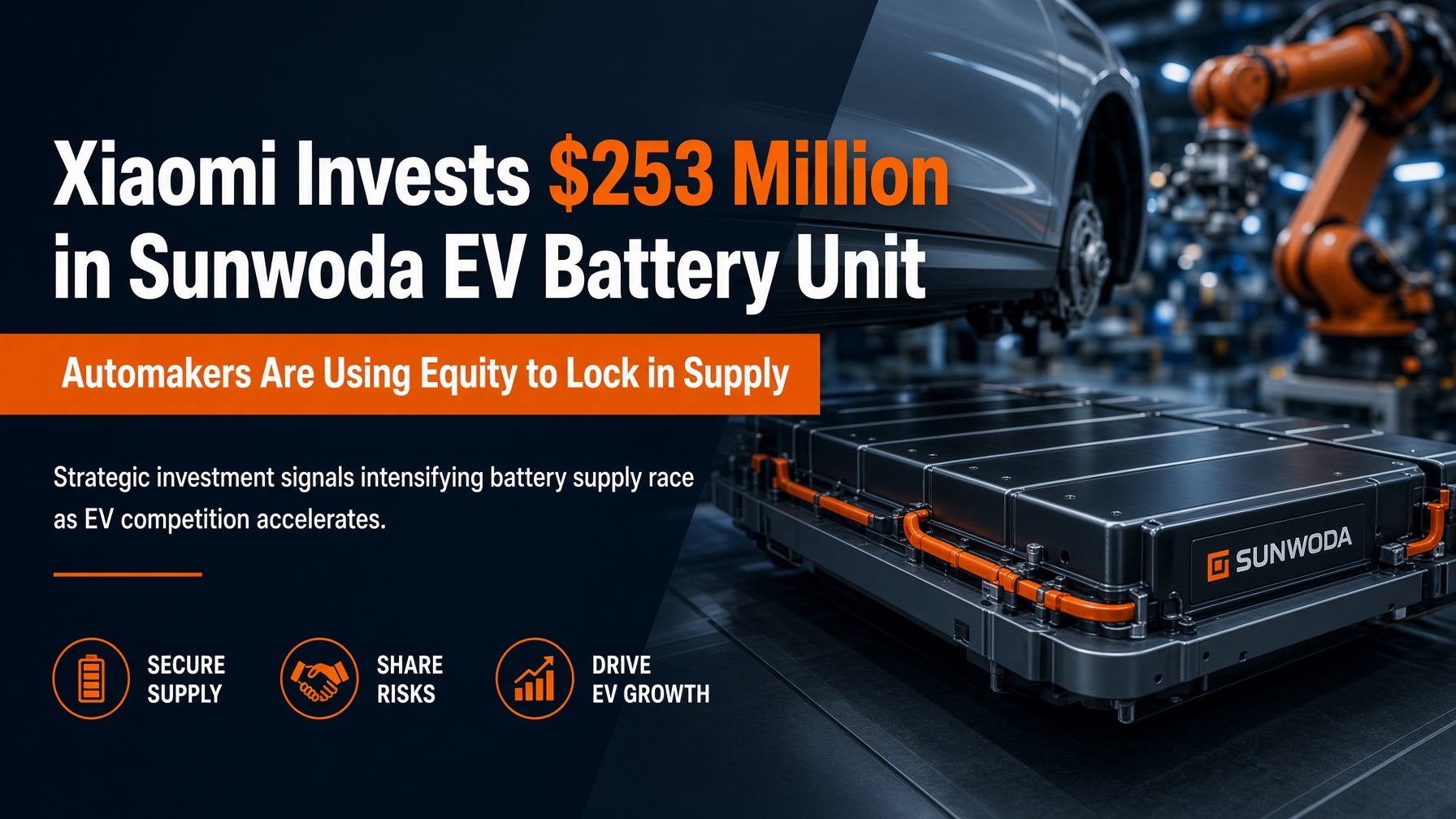
In late October 2026, Sunwoda Electronic announced that Xiaomi, through its wholly owned subsidiary Hanxing Venture Capital, plans to invest RMB 1.7 billion (approximately $253 million) to acquire a roughly 5.34% stake in Sunwoda EVB, becoming the battery maker’s third-largest shareholder. After the deal and a related board restructuring, Sunwoda Electronic will lose control of the subsidiary and cease consolidating its financial results.
On the surface, this looks like a straightforward equity investment. In the context of Xiaomi Auto’s growth phase and the broader battery industry, it represents a deliberate move to strengthen control over a critical part of the supply chain.
From Supplier Relationship to Equity Partnership
The cooperation between Xiaomi and Sunwoda EVB did not begin with this investment. In September 2026, the two companies announced a strategic partnership, with Sunwoda named a core strategic supplier for Xiaomi’s “Dragon Armor” (Longjia) battery program. The Dragon Armor battery is already used in Xiaomi Auto’s Pengcheng (Sky Nomad) series, and Sunwoda built a dedicated production line for the project.
The equity stake upgrades a commercial supply relationship into a deeper partnership. For Xiaomi, the practical benefits are clear:
- Greater involvement in cell R&D, capacity planning, and quality control;
- Reduced dependence on a single dominant supplier (primarily CATL);
- More stable supply during industry cycles of capacity tightness or price volatility.
This approach is not unique to Xiaomi. Li Auto previously invested in Sunwoda EVB and set up a joint venture with the company. As battery costs remain a large share of vehicle cost, more automakers are willing to use capital to gain influence over key upstream partners rather than relying solely on open-market procurement.
Dragon Armor Battery: Xiaomi’s Focus on Customization and Safety
The Dragon Armor battery is the tangible product of this collaboration. Public information and subsequent coverage highlight a system-level approach to safety rather than simple reliance on a branded cell:
- In a 55°C high-temperature, fully charged state, thermal runaway in a single cell does not spread to adjacent cells;
- Bottom impact protection reaches 500 J, roughly 3.3 times the Chinese national standard of 150 J;
- The design combines aerogel insulation, directional pressure-relief channels, multi-layer bottom protection, and Xiaomi-led BMS and cloud monitoring.
Xiaomi has taken a leading role in pack design, thermal management strategy, and quality oversight, while Sunwoda handles cell manufacturing. This “automaker-defined, supplier-manufactured” model gives Xiaomi more control over product differentiation and allows safety metrics to be communicated clearly to consumers. For the Pengcheng series—positioned as a 200,000–300,000 yuan range-extended SUV—these features align with family buyers’ priorities.
What the Deal Signals for the Industry
The investment points to several broader trends:
- Shifting supply-chain strategies. Even as leading battery makers hold large market shares, automakers are reluctant to remain fully dependent on them. Taking stakes in second-tier suppliers and pursuing deep customization is one way to balance scale with greater control.
- Stability over pure price competition. In a period of fluctuating lithium prices, capacity utilization, and demand, locked-in capacity and joint development can matter more than short-term price concessions.
- More customized batteries ahead. Dragon Armor is not an off-the-shelf product; it is a system defined around Xiaomi’s vehicle requirements. As other automakers adopt similar models, the industry will see both standardized cells and highly customized solutions coexist.
For Sunwoda, bringing in Xiaomi (and earlier Li Auto) as shareholders helps strengthen the unit’s finances and order visibility. After losing control of the subsidiary, the parent can focus more on consumer batteries and energy storage. For Xiaomi Auto, which has seen monthly deliveries climb past 50,000 units, the move helps secure a critical component during its rapid expansion phase.
Looking Ahead
Xiaomi Auto is still in a high-growth period, and batteries remain critical for both cost and safety. The RMB 1.7 billion investment is not enormous in absolute terms, but the strategic intent is clear: deepen the relationship with a key supplier through equity while using co-developed products such as the Dragon Armor battery to create differentiation.
Whether this ultimately translates into cost advantages, more reliable supply, and stronger consumer perception of safety will depend on production yields, real-world performance, and how the Pengcheng models perform in a competitive price segment. For industry watchers, cases of automakers taking stakes in battery makers are becoming more common. Together they sketch a more complex supply-chain picture—neither pure vertical integration nor purely arm’s-length procurement.