
Electrochemical Mechanisms Behind Temperature Dependence
Der Hauptgrund temperature effects on lithium-ion battery available capacity are so pronounced lies in the temperature sensitivity of ionic conductivity, charge-transfer kinetics, and solid-state diffusion. Lithium ions must move through the liquid electrolyte, cross the solid-electrolyte interphase (SEI) on the graphite anode, intercalate into the electrode host lattices, and reverse the process on discharge. Each of these steps has an activation energy that follows an Arrhenius-like dependence: reaction rates slow exponentially as temperature falls and accelerate as temperature rises.
At low temperatures the electrolyte viscosity rises dramatically (sometimes by a factor of four near –10 °C), ionic conductivity drops, and charge-transfer resistance increases. The result is larger polarization: the cell reaches its lower voltage limit earlier, so less of the stored lithium inventory is actually delivered. Simultaneously, the risk of lithium plating and SEI growth rises because the anode potential can fall below 0 V versus Li/Li⁺ under load or during charging.
Low-Temperature Capacity Reduction
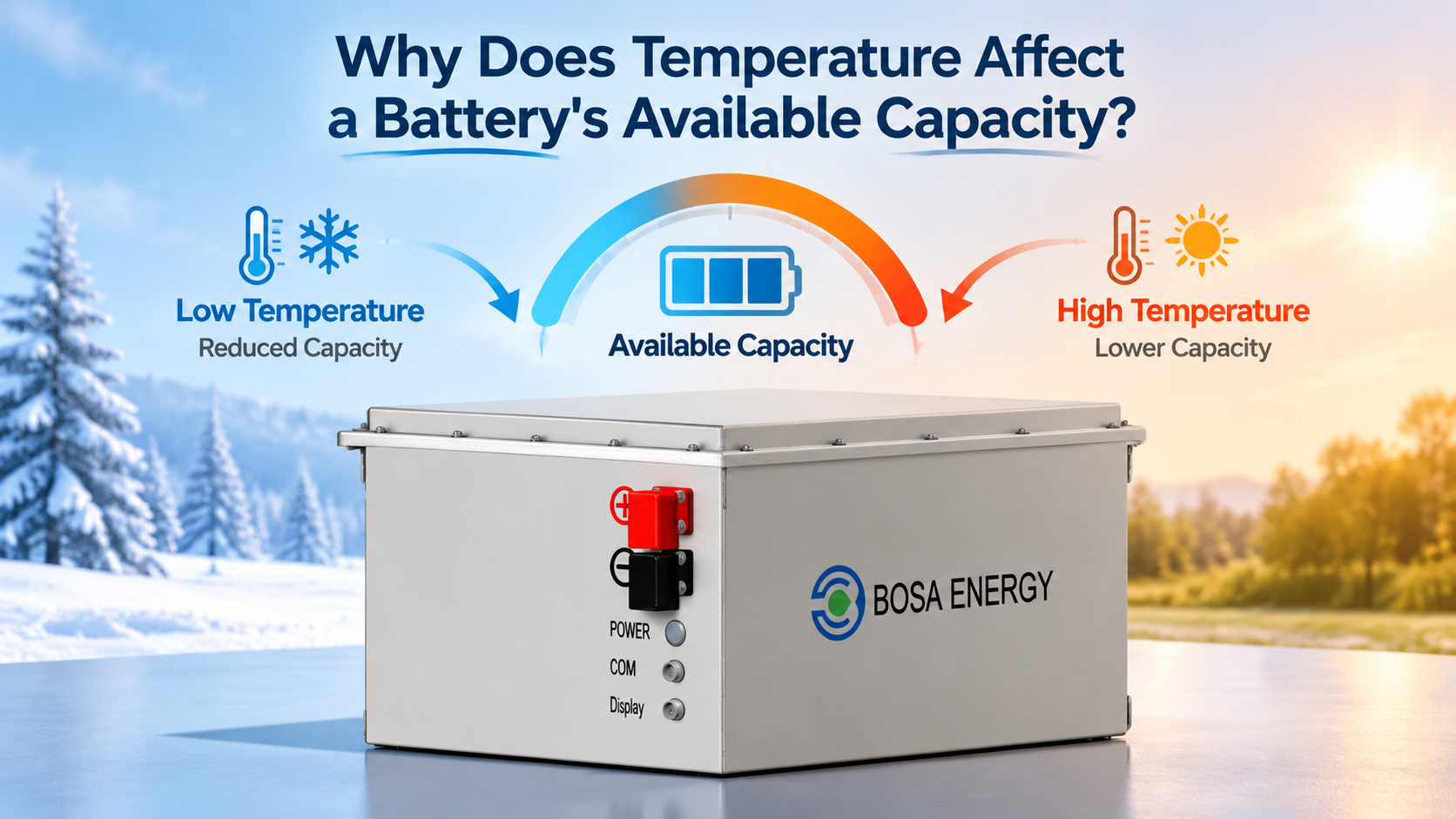
Low-temperature capacity reduction in Li-ion cells is primarily kinetic rather than thermodynamic. The total amount of lithium stored in the electrodes remains largely unchanged, yet the fraction that can be extracted within the allowable voltage window shrinks. Experimental data on 18650 cells show roughly 17 % loss at 0 °C, 34 % at –10 °C, and nearly 50 % at –20 °C relative to 25 °C under moderate C-rates (Battery University and multiple independent studies).
Key contributing factors include:
- Higher electrolyte viscosity and lower ionic mobility, which increase ohmic and concentration polarization.
- Slower solid-state diffusion of lithium in both anode and cathode particles.
- Growth of a more resistive SEI layer and, under some conditions, metallic lithium plating that permanently consumes cyclable lithium.
- Earlier hitting of the discharge cutoff voltage due to the elevated internal resistance.
The capacity loss is largely reversible once the cell returns to room temperature, provided no plating or excessive SEI growth has occurred. However, repeated low-temperature charging can cause irreversible capacity fade through lithium plating and subsequent SEI thickening.
High-Temperature Effects and Accelerated Aging
While moderate warmth can temporarily improve available capacity by enhancing ion mobility and reaction rates, sustained high temperatures trigger high-temperature accelerated battery aging. Above approximately 40 °C, electrolyte decomposition, SEI growth, transition-metal dissolution from the cathode, and loss of active lithium all accelerate. Arrhenius plots of aging rate typically show a clear transition: below ~25 °C lithium plating dominates, while above 25 °C SEI growth and cathode degradation dominate.
Practical consequences include faster calendar and cycle aging, increased self-discharge, and progressive rise in internal resistance. A cell stored or cycled at 45–55 °C may lose capacity several times faster than one kept at 25 °C. Short-term capacity can appear higher (sometimes 100–105 % of the room-temperature value) because of reduced polarization, but the irreversible loss of lithium inventory quickly offsets any temporary gain.
Optimal Operating Window and Practical Implications
Most lithium-ion chemistries (NMC, NCA, LFP, LCO) exhibit best available capacity and longest cycle life between roughly 15 °C and 35 °C. Outside this window, either kinetic limitations or accelerated side reactions reduce the usable energy. Battery management systems therefore actively heat or cool packs in electric vehicles and energy-storage systems to stay near this optimum, especially under high-power demands.
For end users the practical message is clear: avoid prolonged exposure to extreme cold or heat, prefer moderate charge rates in sub-zero conditions, and never charge a frozen lithium-ion cell. Thermal management and chemistry selection (for example, LFP or LTO for better low-temperature tolerance) remain the primary engineering levers for minimizing temperature-induced capacity loss.
Why does temperature affect a battery’s available capacity? In summary, temperature governs the rates of the very reactions and transport processes that determine how much of the stored charge can be delivered before voltage or safety limits are reached. Cold slows everything down and raises resistance; heat speeds the desired reactions but also the parasitic ones that permanently destroy capacity.
Häufig gestellte Fragen
Why does battery capacity drop so much in cold weather? Electrolyte viscosity rises sharply, lithium-ion mobility falls, and internal resistance increases. Polarization causes the cell to hit its cutoff voltage earlier, so less charge is extracted even though the chemical inventory remains largely intact.
Does high temperature permanently damage capacity? Yes. Elevated temperatures accelerate SEI growth, electrolyte oxidation, and transition-metal dissolution, permanently consuming cyclable lithium and active material. Temporary capacity gains are quickly outweighed by irreversible aging.
Is the low-temperature capacity loss reversible? Most of the immediate capacity reduction is reversible once the cell warms to room temperature. Irreversible losses appear mainly when lithium plating occurs during cold charging.
What is the ideal temperature for maximum available capacity? Typically 20–25 °C for peak short-term capacity and 15–35 °C for the best balance of capacity and cycle life across common chemistries.
How can I reduce temperature-related capacity loss in practice? Use thermal management (heating in cold, cooling in heat), avoid high C-rates at temperature extremes, store cells at moderate state of charge, and select chemistries or cells rated for the expected temperature range.